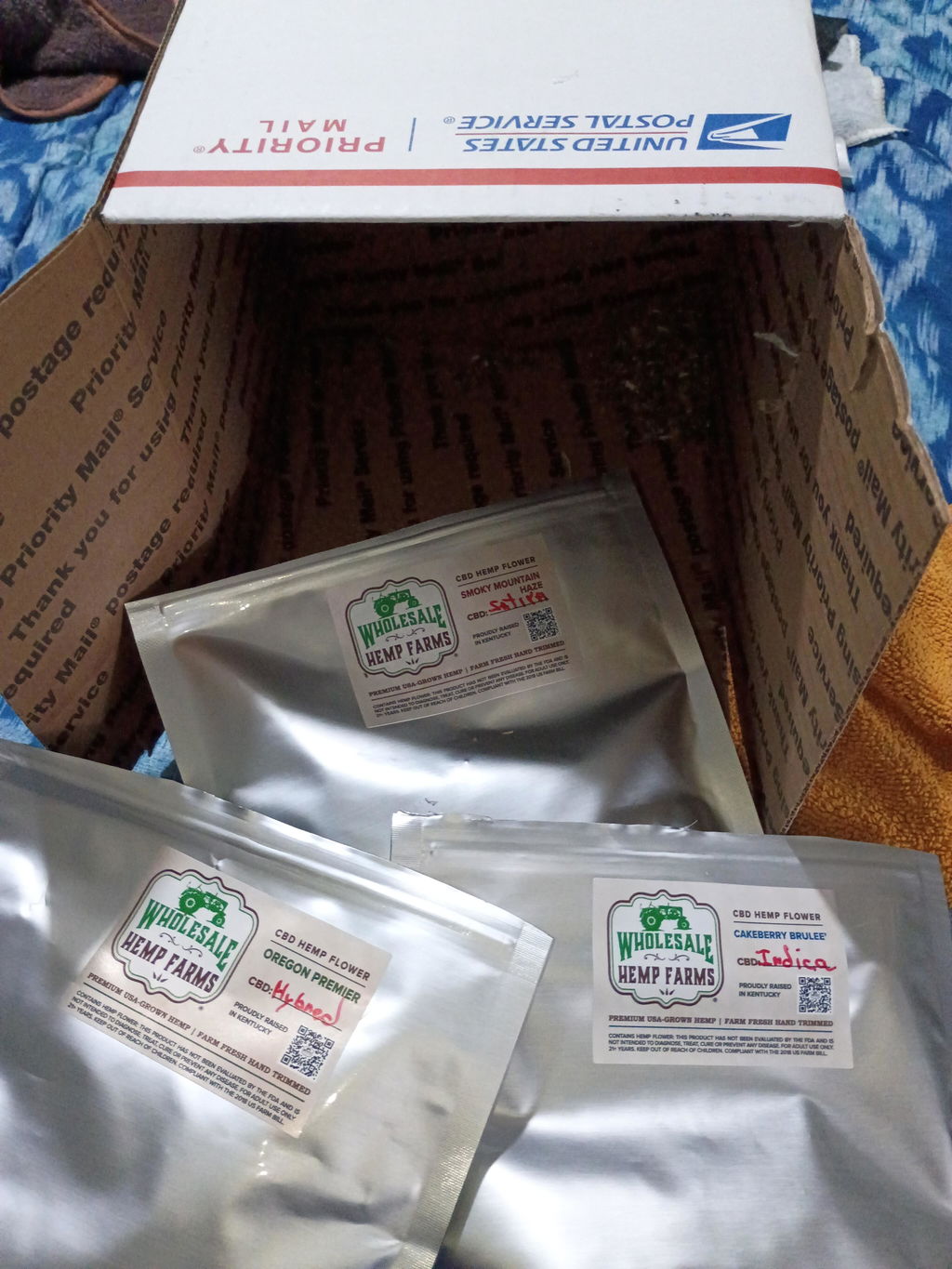
We've been farming hemp in Wilmore, Kentucky since 2018. Every acre we grow is USDA Organic. That certification shapes how we plant, how we weed, how we harvest, and what shows up in the lab report at the end. It's also the reason we can answer this question directly: there's a real difference between organic CBD and non-organic CBD, and for hemp specifically, the difference shows up in ways most crops don't.
This post walks through what USDA Organic actually requires on a hemp farm, why hemp absorbs whatever sits in its soil, what a peer-reviewed study of 202 commercial CBD products found when the researchers tested them for contaminants, and how to tell whether a brand calling itself "organic" is using the word legally or loosely.

What Does "Organic CBD" Actually Mean?
Short answer: the word "organic" on its own is marketing. The phrase "USDA Organic" is a federal certification with annual third-party inspections behind it. Only one of those is legally binding.
USDA Organic Certification vs Marketing Claims
In the United States, a brand can print "organic," "natural," "clean," or "pure" on a CBD bottle without any oversight. Those words mean whatever the brand decides they mean. There's no federal enforcement of the word "natural" on a hemp product label, and there's no penalty for using the word "organic" casually as long as the brand doesn't imitate the USDA seal.
The USDA Organic seal works differently. It's issued under the National Organic Program (NOP), a federal program inside the USDA. To display the seal, a farm has to pass an annual inspection by a USDA-accredited certifying agent. The agent reviews seed sources, soil inputs, pest management, buffer zones, harvesting equipment, storage, and record-keeping. Every input a farmer uses has to appear on the NOP approved list. If something is off, certification gets denied or revoked.
That's why the seal matters. Every farm displaying it has passed that federal audit chain within the last 12 months. You can verify any certified operation in the USDA Organic Integrity Database, which is public and searchable by farm name or certifier.
What the USDA Organic Label Requires for Hemp
For hemp specifically, the NOP standard requires:
- No synthetic pesticides or herbicides. Weeds are managed through cover crops, mulching, cultivation, and hand labor.
- No synthetic fertilizers. Soil nutrition comes from compost, manure, and other NOP-approved inputs.
- Non-GMO seed. Hemp genetics have to come from verified non-genetically-modified sources.
- Buffer zones. Organic fields have to be physically separated from neighboring conventional fields to limit pesticide drift.
- Three-year transition. Any land that was farmed conventionally has to be clean of prohibited substances for 36 months before it can certify.
- Annual inspection. Every year the certifying agent visits, audits records, pulls samples, and re-issues or revokes the certification.
None of that is optional. A farm either does it or doesn't get the seal. You can read more about our own USDA Organic certification on our farm-specific page.
Why Organic Matters More for Hemp Than Most Crops
This is where hemp diverges from most other agricultural products. If a tomato farm uses synthetic pesticides, you can often wash the residue off the tomato. If a cotton farm treats the soil with chemical inputs, the cotton fiber itself doesn't absorb them meaningfully. Hemp is a different kind of plant.

Hemp Is a Bioaccumulator. Here's What That Means
Hemp's root system is efficient enough at pulling substances out of the soil that the plant has been used for phytoremediation, which is the practice of planting a crop specifically to clean contaminated land. After the Chernobyl disaster, hemp was planted near the exclusion zone to help draw radioactive isotopes out of the ground. That same property is why industrial hemp fields are sometimes planted to remediate petroleum spills or heavy-metal-contaminated soil.
Useful trait for a cleanup crop. Problem for a wellness product.
Whatever sits in the soil, whatever drifts in from a neighboring field, whatever pesticide residue is still in the topsoil from a previous conventional crop, the hemp plant takes some fraction of it up and stores it in the leaf and flower. If CBD is then extracted from that flower, any contaminants concentrate along with the cannabinoids in the extract. Concentration is the relevant word. An ounce of flower compresses into a small amount of oil, and whatever was present at parts-per-billion in the biomass can end up at parts-per-million in the tincture.
That's why organic matters more for hemp than for most crops. The plant itself is a collector. The farming practices on the land above it determine what ends up in the extract below it. Starting from clean soil, with NOP-approved inputs and documented buffer zones, changes the contamination math before the plant even emerges from the ground.
What Pesticide and Heavy Metal Testing Reveals
In April 2024, a peer-reviewed study published in Scientific Reports (PMC10982813) tested 202 commercial CBD products purchased off the shelf. The panel included 100 tinctures, 48 gummies, 34 vapes, and 20 topicals.
What the researchers found:
- Heavy metals were detected 52 times across 44 of the 202 products. Lead showed up in 42 of them.
- Pesticides were detected 55 times across 30 products, covering 26 different compounds out of the 232 screened for.
- Residual solvents were detected 446 times across 181 of the 202 products.
Most of those detections sat below state or federal regulatory thresholds. But the study also reported that "25% of all products accounted for 93% of total contamination." In plain language, a quarter of commercial CBD products were carrying almost all of what the researchers found. Five products (3%) exceeded regulatory limits for heavy metals. Three products (1%) exceeded Proposition 65 safe-harbor limits for pesticides.
Organic farming doesn't eliminate trace detection entirely. Soil is soil, and some background level of natural metals exists everywhere. Cutting out synthetic inputs upstream, though, is how you prevent most of what that study measured, instead of trying to catch it afterward with a lab test. An organic farm plus a COA is a belt-and-suspenders setup. The certification prevents contamination at the source, and the COA confirms the prevention actually worked.
How to Tell if Your CBD Is Truly Organic
Three checks, in order.
Look for the USDA Organic Seal (Not Just "Natural")
The seal is a specific green and white circle with the letters "USDA" across a field icon. If a brand carries it, they've been certified by an accredited certifying agent, and that certification is traceable.
If a brand writes "organic" on the bottle but doesn't display the USDA seal, ask to see the certificate. Every USDA Organic farm has a certification document on file from its certifier, and any farm worth buying from will show it on request. Certificates include the certifying agent's name, the certification date, the scope of certified products, and the farm's operation ID.
You can also look up certified operations in the USDA Organic Integrity Database by farm name. If the farm isn't in the database, they're not certified. Simple check, takes about 30 seconds.
Reading COAs for Contaminant Testing
The Certificate of Analysis is the other half of the picture. USDA Organic tells you how the crop was grown. A COA tells you what's actually in the finished product.

A complete COA for CBD should show results across five panels: cannabinoids, heavy metals, pesticides, microbials, and residual solvents. If a brand's COA only shows the cannabinoid panel and skips the contamination panels, that's a gap worth asking about before you buy. A well-run lab will also include the batch number, the sample collection date, the accreditation number of the lab, and the name of the analyst who signed the report.
We have a full walkthrough on our blog about how to read a CBD lab report if you want the longer version. Every batch we ship has a COA posted on our third-party lab results page, searchable by the batch number printed on the product label.
The Real Cost Difference, and Why It's Worth It
Organic hemp costs more to grow. That part is arithmetic.
Weed control on a conventional field is usually a single herbicide pass. On our organic field, it's cover cropping, hand weeding, and cultivation by tractor, repeated through the season. Fertility on a conventional field is a bag of synthetic nitrogen. On our field, it's compost and organic inputs approved under the NOP. Certification itself costs a few thousand dollars a year in inspection fees and paperwork, plus the staff time to keep records the auditor can read. Those records include every input purchase, every field application, every harvest date, and every batch identifier.
Add it up and organic hemp can cost 30 to 50 percent more per acre to grow compared with conventional. Most retail CBD brands pass that premium through with a markup, which is why USDA Organic CBD at retail often costs close to twice as much as non-organic equivalents.
Farm-direct changes that math. When you buy from us, there's no distributor, no retail shelf markup, and no wholesale broker in the middle. The organic premium stays in the growing, not in the middleman layer. That's why our CBD hemp flower prices come in closer to conventional retail pricing even though we're USDA Organic certified.
You still pay for the organic methods. You just don't pay four other people along the way. For a buyer comparing two bottles with the USDA seal, the farm-direct one is almost always the better value, because the price reflects the growing rather than the supply chain.
How Wholesale Hemp Farms Earned USDA Organic Certification
We went through the full NOP process. Here's what it actually looked like for our farm.
Our Kentucky Farm Practices
Our farm sits in Wilmore, Kentucky, about 15 miles south of Lexington. We've been growing hemp here since 2018. The land transitioned to organic practices before we planted our first hemp crop, which means we were clear of synthetic residue well before certification was on the table.
What the day-to-day work looks like:
- Seed: Non-GMO, verified through our seed supplier's documentation.
- Soil: Annual soil tests, compost-based fertility, cover crops between seasons.
- Pest management: Cultivation, beneficial insects, mechanical weed control, no synthetic sprays.
- Water: On-farm well water, tested against NOP standards.
- Buffer zones: Our fields are separated from the nearest conventional operation to limit drift.
- Record keeping: Every input, every application, every harvest gets logged for the annual audit.
During the annual inspection, the certifying agent walks the fields, checks our input records, verifies seed sourcing, and pulls tissue or soil samples where they want independent confirmation. We've passed that inspection every year since we earned the certification, and we'll pass it again the next time the agent shows up with a clipboard. When the auditor has questions, the records answer them. When they want to see a field, we walk them out to it.
We also keep a live farm camera running so buyers can see the field themselves. You can read more on our farm story page.
What Our COAs Show
Every batch of flower, pre-roll, gummy, and tincture we ship is tested by an independent third-party lab before it leaves the farm. The panels cover cannabinoids, heavy metals, pesticides, microbials, and residual solvents. The reports live on our lab results page and are searchable by the batch number printed on the product label.
When you buy a USDA Organic product from a farm that also posts its COAs publicly, you've got both layers covered: how it was grown and what's actually in the finished bottle or bag. That's the standard we hold ourselves to, and it's the standard we'd recommend you hold any CBD brand to.